Introduction
Recent advances in general-purpose multimodal models have led to substantial improvements in visual understanding, spatial reasoning, task planning, and complex instruction following, providing increasingly powerful cognitive foundations for robotics.[1] For embodied intelligence, however, understanding a task is not the same as completing it. A robot must ultimately act in the physical world through continuous perception, decision-making, and execution, while coping with variations in objects and environments, execution errors, and unexpected feedback.[2][3]
This gives rise to a core challenge that distinguishes embodied intelligence from purely digital intelligence: how can general cognitive capabilities be translated into reliable physical action?
Physical tasks require models to learn the relationships among observations, states, actions, and outcomes. A robot must not only identify targets, understand spatial relationships, and plan sequences of operations, but also determine whether an action is feasible, how it will change the environment, and whether the resulting state matches expectations. When a task consists of multiple interdependent steps, the model must also maintain task state over time and adapt subsequent decisions based on new observations and execution feedback. Embodied capabilities therefore cannot be derived from language and visual knowledge alone. They must also be learned from real or synthetic physical interaction experience,[4][5] enabling models to capture how the world responds to actions and to turn that experience into executable behavior.
To address this challenge, Knowin introduces GLOW (Generative Learning of World), a generative learning framework for general-purpose embodied intelligence. GLOW is built on real and synthetic physical interaction experience, uses world rollouts to broaden the model’s exposure to possible action outcomes, and adopts a unified multimodal autoregressive formulation that connects scene understanding, physical reasoning, task planning, and action generation. Closed-loop execution then turns model decisions into physical robot actions. Within GLOW, experience construction, world understanding, model training, action generation, and execution feedback together form a learning loop for acquiring physical interaction capabilities, providing a foundation for task execution across objects and environments.
The goal of GLOW is not to learn a separate policy for every task, but to acquire embodied capabilities that can be reused across objects, environments, and tasks. The model first develops foundational capabilities from physical interaction experience. When presented with a new task, it then combines current observations, task instructions, demonstrations, and other contextual information to invoke, compose, and adapt these capabilities, enabling execution under new task and environmental conditions.
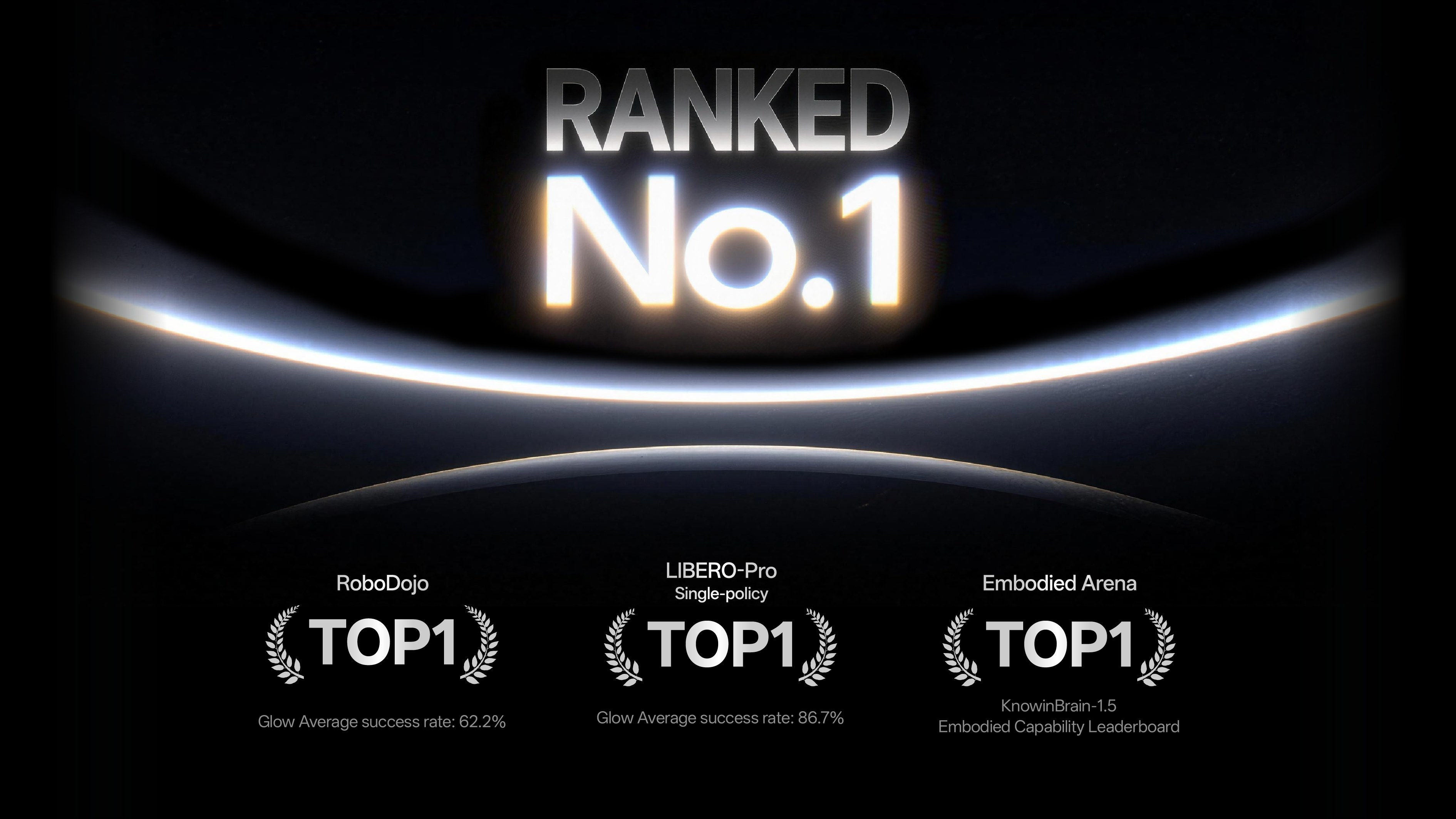
Experimental results show that GLOW not only understands physical scenes, but also translates that understanding into effective task execution. Under the evaluation settings used in this report, GLOW achieves an average success rate of 62.2% across 18 RoboDojo tasks, outperforming the GPT-6 (Robocurve) baseline by 40.0 percentage points. On LIBERO-Pro, GLOW achieves an average success rate of 86.7%, exceeding the corresponding GPT-6 Astra baseline by 28.5 percentage points. For embodied scene understanding, KnowinBrain-1.5 ranks No. 1 on the 2D embodied question-answering leaderboard in Embodied Arena. Together, these results demonstrate GLOW’s capabilities across spatial understanding, physical interaction, and task execution.
Building on these results, this report presents the overall architecture of GLOW, including physical experience construction, world rollouts, multimodal autoregressive modeling, and closed-loop execution. Through real-robot experiments, we further investigate how the model can organize and reuse existing capabilities based on task context. We also demonstrate real-world cases in which the model adapts to a new task from a single demonstration without updating its parameters, exploring a path from autonomous execution toward in-context adaptation and one-shot teaching.
GLOW Architecture: From Experience Generation to Closed-Loop Execution
GLOW is built around KnowinGLOW, a unified multimodal autoregressive model that integrates the former Brain and Act capabilities as BrainSkill and ActSkill within a single model. It jointly learns visual understanding, spatial reasoning, task planning, and action generation. These capabilities are aligned within a shared representation and training framework, connecting scene understanding, task decisions, and physical actions to improve embodied task execution. KnowinDream provides physical interaction experience for training; KnowinWorld supports action-outcome rollouts and embodied alignment; and KnowinAgent (Harness) manages task memory, tool calls, and execution feedback. Together, they form an integrated system from experience-based learning to closed-loop action.
Synthetic Embodied Experience: KnowinDream + KnowinWorld
KnowinDream builds everyday household worlds, KnowinWorld rolls out the consequences of actions within them, and the Experience Compiler turns both into reuseable experiences.
KnowinDream: Generating Realistic Household Life
KnowinDream turns family roles, habits, and home semantics into physically grounded, photoreal household interactions.
KnowinDream runs three engines in sequence.
The Life Engine compiles household roles, habits, and the semantic structure of the home into a Household Program H, which defines the environment, its occupants, their routines and tasks, the current state, and relevant events and constraints. It simulates events as they unfold over time while maintaining two distinct records: the actual state of the home and the robot’s observation history. For example, when a family member moves a cup outside the robot’s field of view, the world state updates immediately, but the robot’s last recorded observation still places the cup at its previous location. Each experience records event timing, visibility, and observation sources, helping the model learn to assess whether past observations remain valid and determine when and where to seek updated information.
The Physics Engine turns the Household Program H produced by Life Engine into an executable 3D environment and simulates how actions and events change that environment over time. Every object in H becomes a 3D body with geometry, physical properties, and joints, and every action has to be physically possible: “put the cup in the cabinet” proceeds only if the cup is reachable, the door is open, and the grasp holds. The resulting motion and contacts come from physics simulation rather than being written into the program, and their effects persist—an opened door stays open and limits what the robot can reach next. The output is a Grounded Trajectory τ: a time-aligned record of actions, contacts, and object states in which every step is physically feasible and every label is read directly from the simulation, so it is correct by construction.
The Dream Engine renders Photoreal Experience X around τ and varies it in appearance (lighting, materials, backgrounds), object (structurally compatible substitutes, re-executed in the Physics Engine), and scene (home, camera view, robot configuration), while the interaction itself stays the same. The model thus sees one manipulation relationship across many appearances, objects, and viewpoints.
KnowinWorld: Action-Conditioned World Rollouts
Understanding the world includes anticipating the consequences of actions. Research on mental simulation explains human judgments about scene changes through approximate physical rollouts. Starting from the current state, KnowinWorld predicts subsequent changes conditioned on candidate actions, connecting current observations to possible contacts, motions, and state transitions. Multiple views, robot state, task context, and 3D structure jointly form a task-relevant spatial latent state zt. This representation captures spatial relationships among objects, the robot’s location, and the goal currently being pursued.
Conditional dynamics applies candidate action sequences to the spatial latent state and rolls out future states under constraints such as collision, contact, reachability, and object permanence. Picking up a cup therefore consists of a continuous sequence of approach, contact, grasp, and lift. The state produced at each stage becomes the starting point of the next.
Conditional Dynamics and Candidate Evaluation
Here, zt is the current spatial latent state; A(j) = (at(j), …, at+H−1(j)) is candidate action sequence j, containing H actions and corresponding predicted states from t+1 to t+H; Cphys and b denote physical constraints and embodiment conditions, respectively. Fφ predicts the state sequence Ẑ over the next H steps, with dynamics-model parameters φ. S scores predictions against task goal g, and j⋆ identifies the highest-scoring branch among the J current candidates.
From a shared initial state and task goal, the model compares contact, displacement, and task progress along candidate paths to select subsequent actions.
Varying the action from the same starting point produces comparable future branches. When picking up a cup from a table, different approaches and contact patterns may cause collisions with nearby objects, tip the cup, or complete the grasp. A world-outcome evaluator ranks candidate branches by task progress, physical consistency, reachability, risk, and prediction uncertainty, providing their key consequences to the decision layer.
These branches also expand training experience. Successful actions, failures, and recovery sequences share the same initial state while preserving different action-outcome relationships. Dream provides diverse worlds and interactions, while World further unfolds their consequences. Together, they supply data for learning physical causality and task decisions.
Experience Compiler: Compiling Physical Experience into Supervision
Experience Compiler converts visual observations, action trajectories, world states, visibility, and outcome records into training samples. Observation-action pairs support behavior generation; state-action-outcome tuples support world prediction; and complete trajectories with outcomes support task-progress assessment. Different supervision signals share object identities, timing, and interaction context from the same experience.
Grounded Experience provides actions, contacts, and object states from physical interactions. Anchored Generative Experience expands visual and semantic conditions around those interactions. Dreamed Experience unfolds candidate futures and their outcomes. Experience compilation organizes these sources into model inputs and outputs, directly connecting data generation to specific learning objectives.
Experience Compilation and Supervision
Here, ℰ denotes the collection of experiences; τe records the physical trajectory and world state of experience e, while Xe records the corresponding visual experience. Compilek produces training samples for supervision type k, which are combined into dataset 𝒟k. Types k may include action generation, future prediction, state understanding, or outcome assessment.
Compilation changes how inputs and targets are organized while preserving object identities, temporal alignment, and physical processes. A single interaction can therefore support multiple training objectives.
| Experience | Input–Target Mapping | Supported Capability |
|---|---|---|
| Observations and actions | Current image, task, and robot state → end-effector action / gripper control | Generate the next action from current conditions |
| States and outcomes | Current world state + candidate action → subsequent state changes | Action-conditioned future prediction and physical reasoning |
| Events and visibility | Observed events, times, and sources → state and belief updates | Temporal understanding and task-information organization |
| Trajectories and results | Continuous interactions → task progress, outcomes, and path evaluation | Stage assessment, outcome verification, and candidate comparison |
| Adjustment and recovery | States encountered during interaction → corrective actions and subsequent steps | Continue and replan based on feedback |
KnowinWorld in Action: Dual-Arm Simulated Tasks
Tube insertion, bowl stacking, and block stacking illustrate KnowinWorld’s dual-arm simulation tasks. The arms switch roles during approach, alignment, insertion, handover, and placement. The manipulation arm advances the interaction, while the observation arm changes viewpoint to capture spatial relationships between objects and targets. Together, they generate continuous interaction experience.
During local manipulation, RGB-D observations and selected pixel positions provide geometric references; wrist-camera motion adds contact and alignment information. The task layer sets stage goals, while the interaction layer acts on current geometry and returns results. New observations between actions keep subsequent decisions aligned with the scene.
Two Views of the Same Interaction
The video follows a robot as it grasps a bottle lying on the table, rotates it upright, and sets it down. The wider scene view shows the bottle in relation to surrounding objects, while the close-up view reveals the gripper’s contact and motion. Together, the two views connect physical interaction with the changing state of the scene throughout the task.
KnowinWorld · Dual-arm simulated interaction. Scenes, tasks, multiple views, and action outcomes form continuous embodied experience.
KnowinWorld builds interactive virtual worlds with high-fidelity physical interactions and visual appearance. Together with KnowinDream, it supports high-fidelity scene randomization, broadening the distribution of training data across visual, spatial, and physical-interaction conditions. This provides data for multidimensional distribution generalization in embodied foundation models. The following bowl-stacking task illustrates this data-generation approach.
KnowinDream supplies the household scenes and events, KnowinWorld supplies the consequences, and the Experience Compiler consolidates both into training experience for observation understanding, spatial reasoning, task planning, and action generation.
A Unified Autoregressive Embodied Model
Model observations, tasks, history, and actions in a unified autoregressive sequence.
Multimodal Task Context
GLOW’s model core uses a native autoregressive architecture. Images and videos from robot cameras, user language, robot state, and execution feedback jointly form its inputs. Conditioned on the current task and progress, the model generates subsequent judgments and actions. Real first-person experience and synthetic experience organized by KnowinDream and KnowinWorld are used together in training to connect scene understanding, physical reasoning, and task decisions.
Vision identifies objects and states; language specifies goals and rules; proprioception describes execution conditions; and history retains actions and outcomes. The model combines this information to generate the current action. As the task advances, new observations and feedback enter the context and drive the next decision.
Autoregressive Modeling and Sequence Supervision
Autoregressive modeling learns how successive outputs depend on their preceding context. Current observations and task information form a conditioning prefix, and newly generated outputs are appended to the same sequence. Object localization identifies the entities needed for relational judgments; spatial and physical reasoning guide action selection; and action outcomes inform the next round of reasoning. Multiple decisions within a task therefore remain connected to a shared goal.
Autoregressive Modeling and the Sequence Supervision Objective
Here, C is the context comprising observations, task information, proprioceptive state, and history; Y = (y₁, …, yN) is the target token sequence, including an end token; y<i denotes the target tokens before the current position; θ denotes model parameters. ℓseq is the negative log-likelihood of one target sequence, used for sequence-supervised training.
The probability factorization expresses each output’s dependence on context, while negative log-likelihood expresses sequence supervision as a sum of per-token losses. Training and inference share the same conditional formulation.
Training samples provide specific supervision for these conditional relationships. Object-and-attribute samples connect visual regions to semantics; spatial samples connect reference objects to relative relationships; interaction samples connect actions to state changes; and planning samples connect the current stage to the next step. Experience compilation preserves object and temporal correspondences across these samples, allowing different supervision signals to serve the same embodied task interface.
Multi-Capability Pretraining and Spatial–Action Alignment
Pretraining spans diverse household environments and combines real first-person experience with synthetic experience. It learns object identities, reference relationships, reachable regions, action processes, and scene changes across spatial layouts, viewpoints, object appearances, and placements. Multi-stage pretraining organizes supervision for spatial localization, relational judgment, state understanding, and task planning. This establishes relationships among objects, reference entities, target regions, and the robot’s body, developing transferable spatial understanding of household scenes.
Post-training first strengthens and aligns spatial understanding, task planning, and action execution separately through reinforcement-learning exploration, using task feedback to reinforce reasoning and goal-directed behavior. MOPD then integrates these enhanced capabilities within a unified optimization process, further coordinating spatial judgment, action generation, and execution feedback so that understanding, planning, and execution serve the same task.
This alignment spans task stages. Approach emphasizes target position and reachable paths; grasping emphasizes the grasp relationship and object response; transport emphasizes the object’s position relative to the target region; and contact emphasizes action-induced state changes. Each stage links its actions to scene conditions and outcomes, forming a task process that supports continued reasoning.
| Stage | Data and Model Processing | Resulting Task Capabilities |
|---|---|---|
| Experience organization | Align observations, states, actions, and outcomes across real first-person data and synthetic experience. | Maintain consistent object identities, timing, and interaction context. |
| Pretraining | Learn objects, relationships, actions, and scene processes from visual and task experience. | First-person understanding, spatial relationships, and physical interaction understanding. |
| Spatial–action post-training | Enhance and align capabilities separately through reinforcement-learning exploration, then integrate them through MOPD. | Connect scene judgments to goal-directed action representations. |
| Execution-interface alignment | Unify coordinates, units, and execution bounds for end-effector pose and gripper control. | Connect model-generated EEF actions to robot motion execution. |
Learning Relationships Across Appearances, Objects, and Views
Synthetic experience provides systematic variation in conditions. Appearance expansion places the same interaction relationship in different visual environments; object substitution exposes the model to different geometries and affordances; world-configuration changes connect viewpoints, embodiments, and spatial layouts; and candidate futures compare action choices and outcomes from a common starting point. Together, these samples help the model distinguish invariant task relationships from changing conditions.
The unified model learns relationships among objects, space, actions, and goals. For a new task, it combines task information, current observations, and interaction history to generate actions, then continues reasoning and planning from execution results.
Embodied In-Context Learning in GLOW
Teaching provides task rules, current observations provide execution conditions, and the model connects the two.[6]
GLOW incorporates task descriptions, demonstrated object relationships, operation order, and target states into runtime context. The model interprets the teaching, maps demonstrated relationships to the current scene, and generates subsequent judgments and actions. User teaching thus directly informs task execution.
Embodied teaching specifies both task goals and completion conditions: object references identify what to manipulate, spatial relationships specify target regions, step dependencies establish operation order, and target states define completion criteria.[7] The model uses this information to understand the task and updates progress from new observations and execution feedback.
Mapping Objects and Relationships Across Scenes
GLOW uses first-person understanding to identify objects, attributes, and actions, and spatiotemporal localization to determine target regions, reference points, and event order. These capabilities map demonstrated objects and relationships to the current environment.
When executing “place the object in the target container,” the model combines the relative positions of the carried object, container, and robot end effector. Current views and on-demand spatial queries determine how to approach and align. The demonstrated task relationship thereby becomes a concrete operation.
Task Decomposition and Stage Progression
The sequence in a demonstration provides task structure. Approach, grasp, lift, transport, and alignment depend on different scene conditions and produce different state changes. The model uses current observations to identify the task stage, connects demonstrated steps to progress already made, and generates the next step.
Goal-directed planning bridges these stages: it works backward from the target state to select actions that can advance the task under current conditions. After execution, new object states and interaction outcomes determine whether to proceed to the next stage. Teaching provides overall direction, task history maintains continuity, and real-time observations provide current evidence.
Teaching Context and Physical Feedback
Object position after gripper closure, whether an object moves with the gripper during a test lift, and drawer response to an outward pull continuously reflect task progress. Harness incorporates this information into execution receipts so that the next decision can use the original goal, teaching context, and latest interaction results together.
One-shot teaching spans task understanding and execution: the user expresses intent through teaching, the model maps the demonstration to the scene, the execution system carries out actions, and feedback updates decisions. Starting from one teaching example, the robot completes the task in its current environment.
| Teaching Information | Role in the Current Context | Connected Capabilities |
|---|---|---|
| Objects and references | Match demonstrated objects to targets in the current view. | Object understanding, attribute recognition, and region/reference-point localization |
| Spatial and goal relationships | Use current spatial relationships to organize approach, transport, and alignment. | Spatial relationships, free space, and multi-view physical reasoning |
| Steps and operation order | Connect completed stages to subsequent actions. | Action understanding, next-step prediction, and multi-step planning |
| Completion conditions | Assess progress from post-action object states and task outcomes. | Interaction-outcome reasoning, success verification, and progress assessment |
Closed-Loop Execution of Long-Horizon Tasks
Action representations connect the model to control. Harness keeps observations, tools, memory, and feedback aligned with a shared goal.
KnowinGLOW: Direct EEF Action Generation
KnowinGLOW connects model outputs to robot motion execution. Conditioned on images, task goals, robot state, and interaction history, it directly generates end-effector (EEF) poses or pose increments, along with gripper control. The motion interface executes requests and returns new observations, proprioceptive states, and results to condition the next action.
Actions preserve temporal structure and stage relationships. Filling a cup, for example, involves reaching for the cup, grasping and transporting it, aligning and placing it, and pressing the dispenser. The object and end-effector states produced by each stage determine the execution conditions of the next. Action representations are linked to these motion processes, grounding task reasoning in specific movements, poses, and contacts.
Context-Conditioned End-Effector Action Generation
Here, Ct is the current task context, πθ is the action policy, ct is gripper control, and ξt denotes end-effector action parameters. Pose requests specify target position and orientation; incremental requests specify relative translation and rotation. The corresponding action interface standardizes reference frames, rotation representations, and units.
The model uses pθ to generate token sequences autoregressively. Action parsing converts them into end-effector commands associated with policy πθ . New observations and results from each execution enter the next context and drive subsequent actions.
Cup grasping and transport focus on object pose, end-effector orientation, and the grasp relationship. Alignment and placement focus on the cup’s offset from its target, while pressing focuses on button state and device changes after contact. New visual observations, proprioceptive states, and action feedback re-enter the context to guide subsequent generation. The task advances through connected end-effector actions.
KnowinAgent(Harness):A Context-Driven Task Runtime
Task context determines how existing capabilities are invoked and organized. Cognitive-control theory emphasizes maintaining goals and the means to achieve them in order to organize perception, internal states, and behavioral outputs. Harness connects goals, observations, memory, tools, and feedback within a single robot runtime. Each reasoning step can access the original goal, current external and wrist-camera images, robot state, recent tool results, and task progress. The model selects what information to obtain, what actions to take, and which outcomes justify continuing; the runtime handles calls, execution, and logging.
Goals guide tool selection and action planning; memory retains task stages and progress; tools provide the measurements and execution interfaces needed at each moment; and feedback informs later judgments. Bottle necks, handles, and container regions identified visually become spatial queries, providing geometric references for approach and alignment. After motion execution, actual displacement, gripper state, and new camera images are returned together. Each tool call preserves the connection from task intent to physical outcome, keeping successive interactions aligned with the same goal.
On-Demand Spatial Queries and Adaptive Action Granularity
Harness supports spatial queries for regions and points, relative geometry, selected-feature tracking, and candidate gripper-pose checks. The model chooses query targets for the current stage, converting visually identified objects into spatial references for execution. Relationships between carried objects and target containers guide alignment near the end of transport.
Action granularity adapts to the interaction stage. In open space, move_toward delegates longer-distance motion to the local controller. Near a bottle neck, bowl rim, or drawer handle, the model uses bounded small movements and observes again between adjustments. The same task context connects long-distance motion to fine local manipulation.
| Interface | Input | Return Value and Purpose |
|---|---|---|
| Region / point spatial query | Selected regions or points in external or wrist RGB-D views. | Returns visible-surface geometry as a manipulation reference. |
| Relative geometry query | Selected reference positions on carried objects, target containers, and other entities. | Returns relative geometry for approach and alignment after transport. |
| Tracking and pose checks | Selected features and candidate gripper poses. | Maintains target correspondence and informs approach direction and orientation. |
| move_toward | A motion target selected by the model. | The local controller executes motion and returns motion records and new observations. |
| Small movements / gripper operations | Relative displacement or a gripper operation. | Returns actual displacement, gripper state, and post-action observations. |
| History retrieval / progress logging | Relevant history, current stage, milestones, or evidence references. | Continuously organizes actions and outcomes throughout the task. |
| Task completion check | Current simulation state and a completion request. | Returns the result of checking task-success conditions. |
Execution Receipts and Closed-Loop Decisions
Execution receipts record actual displacement, remaining target error, gripper state, and new observations. The model compares requests with results to assess progress, then decides whether to continue approaching, change orientation, or advance to the next stage.
Short test lifts and pulls both advance the task and verify contact relationships. A test lift checks the grasp by observing whether the object moves with the gripper; a test pull checks engagement through the drawer’s response. These observations directly inform the next action.
Executed Displacement and Feedback Residual
Here, pt and pt+1 are the end-effector positions before and after a move; Δptcommand is the requested translation, and Δptactual is the actual translation. Both use the same fixed reference frame and length units; rt is the displacement residual for this move.
The residual captures the difference between requested motion and actual progress. Combined with gripper state, contact information, and new observations, it supports decisions to continue approaching, change orientation, or make local adjustments.
Hierarchical Memory and Long-Horizon Task State
Task memory retains the original goal, current stage, completed milestones, and supporting evidence. Recent observations and tool receipts remain in detailed context, while the full episode history supports on-demand retrieval. Local operations therefore remain connected to overall task progress.
Object and region identities remain associated across interaction rounds, while new geometric measurements update with current observations. The model can review earlier attempts and outcomes, then plan the next step using the latest positions. Memory preserves task continuity and real-time perception updates scene conditions; together, they support ongoing decisions.
| Feedback | How the Model Uses It |
|---|---|
| Requested × actual displacement | Compare motion goals with actual progress to plan further approach or pose adjustment. |
| Remaining target error | Determine the direction and magnitude of the next move from current error. |
| Gripper state × object response | Assess grasp or pulling engagement using test lifts, test pulls, and visual changes. |
| Post-action multi-view observations | Use updated object positions, contact relationships, and spatial changes in the next judgment. |
| Stage records × completion checks | Update task milestones, transition to the next stage, or finish the task. |
KnowinGLOW unifies goal understanding, reasoning, planning, and EEF action generation. The motion interface executes actions on the robot, while Harness manages tools, memory, and feedback. The model, motion interface, and runtime jointly sustain a task loop in which every observation and action serves the same goal.
Embodied Understanding and Task Reasoning
First-person understanding, spatiotemporal localization, physical reasoning, and task planning support teaching interpretation and execution decisions.
GLOW’s embodied understanding and reasoning span 18 problem domains in four categories, including object attributes and spatial relationships, target-region localization, interaction-outcome assessment, and task planning. The examples below use input images, task questions, and model responses to show how these capabilities support specific decisions.
Comprehensive First-Person Understanding
- Object and attribute understanding
- Spatial relationship understanding
- Counting and measurement estimation
- Temporal and action understanding
- First-person text and symbol recognition
Diverse Spatiotemporal Localization
- Object and reference-point localization
- Free-space and region localization
- Manipulation target-point localization
- Temporal ordering and episode localization
Physical Grounding
- Affordance and functional reasoning
- State estimation and state-change reasoning
- Trajectory and interaction-outcome reasoning
- Contextual and multi-view reasoning
Physics-Aware Planning
- Goal-conditioned next-action prediction
- Multi-step manipulation planning
- Action feasibility and success verification
- Failure awareness and closed-loop replanning
- Navigation and path planning
Placing a Lid on a Teacup
-
01
Planning
Model output · Subtask chaingrasp_knob → lift_lid → align_over_rim → lower_to_closeExplanationThe four steps are to grasp the wooden knob, lift the lid, move above the cup and align with its rim, and lower the lid to close it. The image shows the pre-contact phase of step 1, with the gripper already positioned on either side of the lid.
-
02
Grounding
Model output · Knob bbox [x1, y1, x2, y2][786, 136, 940, 282]ExplanationCoordinates refer to the 1400×700 wrist-camera image. The box center, [863, 209], is the grasp reference point and determines lateral offset; depth provides the height difference. At this moment, the knob lies between the fingers but has not yet been grasped.
-
03
Action
Model output · delta_xyz · m · End-effector frame[0, −0.006, −0.015]ExplanationA bounded pre-contact correction compensates for 6 mm of lateral offset along y and lowers the gripper by 15 mm along z to a suitable closing height. Once the execution receipt returns actual displacement, the gripper closes and performs a test lift to confirm the grasp before proceeding to step 2.
The model coordinates these capabilities during a task: recognizing objects and actions, locating manipulation targets, assessing interaction outcomes, and planning the next step. Teaching and real-time observations provide decision context, while execution feedback continuously updates task state.
One-Shot Teaching
One-shot teaching arises from the in-context learning (ICL) capabilities of GLOW’s unified multimodal autoregressive model. The robot observes a single human demonstration, and Skill Demo Encoder applies task-oriented spatiotemporal encoding to the continuous visual experience to produce Reusable Skill Context. Its semantic layer can align with chain-of-thought (CoT) language instructions. The model combines this context with current observations, language instructions, robot state, and interaction history to generate scene-appropriate judgments and actions, while its parameters remain unchanged during execution. The watering examples illustrate object generalization, while the box-storage examples illustrate generalization across both objects and positions.
From Spatiotemporal Understanding to Reusable Skill Context
Skill DIY defines a task through one continuous human demonstration. Skill Demo Encoder jointly interprets objects, physical interactions, and state changes across frames, consolidating task-relevant visual experience into Reusable Skill Context. This context carries task intent and physical interaction knowledge and aligns with language instructions, making the demonstration a reusable task reference for subsequent execution.
Reuse preserves task knowledge while updating execution conditions: skill context CD provides a task reference, while current observations, language instructions, proprioceptive state, and interaction history describe the conditions on site. Together, they form Ct. GLOW generates concrete actions from these conditions so that the same skill adapts to changes in tools and positions. Users can also adjust goals and execution methods through language. ICL performs task adaptation at runtime while model weights remain fixed.
Single Demonstration → Reusable Skill Context → Scene-Conditioned Execution
Notation: D is a single demonstration; CD = Φθ(D) is the Reusable Skill Context encoded from the demonstration video by Skill Demo Encoder. It carries transferable task intent and physical interaction knowledge, with a semantic layer that can align with CoT language instructions.Ct comprises current observations Ot, language instructions L, robot state st, interaction history Ht , and reusable skill context CD . Following the notation in the main text, Y = (y₁, …, yN) is the target token sequence, y<i denotes previously generated tokens; pθ denotes the unified sequence distribution, πθ the corresponding action policy, and at the current action. θbase and θtest denote deployed weights before teaching and weights during execution, respectively.
Skill context CD provides a reusable task reference, while runtime context Ct updates with current observations, language requirements, and execution feedback. ICL occurs as GLOW uses these conditions to generate judgments and actions token by token: task knowledge is reused, behavior adapts to the scene, and model weights remain unchanged.
A single demonstration is encoded into reusable skill context through task-oriented spatiotemporal encoding. Task intent and physical interaction experience transfer across scenes, while GLOW generates specific actions based on current observations and language instructions. In-context learning adapts to the task while model parameters remain fixed. The image stacks, encoder, representation blocks, and generalization links are schematic illustrations of the mechanism.
One Demonstration Drives Task Adaptation
One-shot teaching turns GLOW’s physical capabilities into task capabilities that users can invoke directly. A single demonstration supplies operation structure, current observations establish execution conditions, and closed-loop feedback advances completion. The box-storage and watering examples show adaptation to changes in objects and to joint changes in objects and positions.
This interaction lets users communicate operational intent through demonstrations, while the robot adapts to the scene using its existing understanding, reasoning, and action capabilities.[8] From autonomous execution to demonstration-driven behavior, GLOW provides a unified path for robots to receive, understand, and complete tasks.
GLOW’s Embodied Capabilities: From Scene Understanding to Task Completion
GLOW demonstrates strengths in both embodied understanding and task execution. Under this report’s evaluation conditions, it achieves average success rates of 62.2% on RoboDojo and 86.7% on LIBERO-Pro, improving on the respective GPT-6 (Robocurve) and GPT-6 Astra baselines by 40.0 and 28.5 percentage points. KnowinBrain-1.5 ranks No. 1 on Embodied Arena’s 2D embodied question-answering leaderboard. The following evaluations and execution examples show these capabilities in spatial judgment, physical interaction, and task completion.
RoboDojo: 62.2% Average Success Across 18 Tasks
Across 18 simulated RoboDojo tasks, GLOW achieves an average success rate of 62.2%, improving on GPT-6 (Robocurve)’s 22.2% by 40.0 percentage points. Its average score reaches 71.1, an increase of 41.3 points over the baseline’s 29.8.
Higher Success Rates and Progress Scores
Average success rate
Average score
LIBERO-Pro: 86.7% Average Success
Across six perturbation conditions in LIBERO-Pro’s Object, Goal, and Spatial sets, GLOW running independently achieves 86.7% average success, 28.5 percentage points above GPT-6 Astra’s 58.2%, and leads on five of the six conditions. Improvements are particularly pronounced for Spatial position swaps and Goal task perturbations. Bottle-grasping and drawer-opening executions further show how GLOW combines spatial judgment, action control, and real-time feedback to complete tasks.
Overall Results: 28.5 Percentage Points Above GPT-6 Astra
The evaluation covers the Object, Goal, and Spatial task sets, each with position swaps (Pos.) and task perturbations (Task). Position swaps change the initial spatial configuration; task perturbations change task conditions. Success is determined by the simulator’s native criteria.
LIBERO-Pro Success Rates by Method
| Category | Method | Spatial | Object | Goal | Average ↓ | |||
|---|---|---|---|---|---|---|---|---|
| Task | Pos. | Task | Pos. | Task | Pos. | |||
| Mixture-of-policies | RPent / GPT-6 Astra Codex | 100 | 98 | 100 | 99 | 88 | 99 | 97.3 |
| Mixture-of-policies | Harness VLA (Claude Code) | 94 | 80 | 88 | 90 | 87 | 87 | 87.7 |
| Single-policy | GLOW | 59 | 97 | 97 | 97 | 97 | 73 | 86.7 |
| Mixture-of-policies | Harness VLA (Codex) / RPent GPT-5.5 · xhigh | 81 | 69 | 94 | 91 | 75 | 66 | 79.3 |
| Mixture-of-policies | RPent Flash Mode Molmo2-8B · visual localization | 79 | 70 | 86 | 93 | 74 | 65 | 77.8 |
| Mixture-of-policies | RPent / Qwen3.6 27B no-reasoning | 82 | 78 | 83 | 84 | 68 | 68 | 77.2 |
| Single-policy | ASPIRE | 60 | 51 | 95 | 98 | 45 | 81 | 71.7 |
| Single-policy | GPT-6 Astra | 41 | 24 | 89 | 59 | 41 | 95 | 58.2 |
| Single-policy | π_RLinf | 42 | 59 | 71 | 78 | 45 | 42 | 56.2 |
| Single-policy | RATS | 31 | 29 | 63 | 61 | 36 | 43 | 43.8 |
| Single-policy | Cap-X | 14 | 12 | 18 | 22 | 17 | 26 | 18.2 |
| Single-policy | π₀.₅ | 1 | 20 | 1 | 17 | 2 | 38 | 13.2 |
| Single-policy | AtomVLA | 1 | 16 | 0 | 10 | 11 | 2 | 6.7 |
| Single-policy | X-VLA | 0 | 0 | 8 | 2 | 9 | 1 | 3.3 |
| Single-policy | MolmoAct | 0 | 0 | 0 | 6 | 0 | 0 | 1.0 |
| Single-policy | π₀ | 0 | 0 | 0 | 2 | 0 | 0 | 0.3 |
| Single-policy | OpenVLA | 0 | 0 | 0 | 0 | 0 | 0 | 0.0 |
| Single-policy | NORA | 0 | 0 | 0 | 0 | 0 | 0 | 0.0 |
With a single policy, GLOW achieves an average success rate of 86.7% across the six LIBERO-Pro tests, ranking first among the single-policy models in the table and exceeding runner-up ASPIRE by 15.0 percentage points. Compared with mixture-of-policies systems, GLOW approaches Harness VLA (Claude Code) at 87.7% and exceeds the other three such systems listed, demonstrating cross-task execution with a unified policy.
These results show that a single GLOW policy can perform comparably to some multi-policy systems while maintaining the highest average among the single-policy models evaluated.
Execution Examples: Spatial Judgment and Action Feedback
The six paired recordings below show both systems executing the same tasks from identical initial states. GPT-6 Astra with native RGB input is on the left, and GLOW is on the right. GLOW passes the native success check in these examples; the baseline does not. Failing the check, however, does not mean every part of the operation was incorrect. In particular, Astra completes the main manipulation steps in all three bowl-to-plate tasks, with differences concentrated in final precise placement. The videos and actual execution-step counts help distinguish benefits from smoother motion, more accurate placement, and additional corrective actions.
Select a task above to view paired recordings: Astra on the left, GLOW on the right. Within each video, the external view is on the left and the wrist view on the right. Playback defaults to 0.5×, and each video can be viewed fullscreen. Original execution durations are preserved; task stages are not forced into synchronization.
Precise Placement Determines Task Completion
In all three bowl-to-plate recordings, Astra selects the correct target and completes grasping and transport, but its final placement does not meet the native success criteria. The differences are concentrated in final alignment, rather than errors throughout the entire task.
GLOW adjusts in stages based on the object’s position relative to the target plate, leaving opportunities to observe and correct before contact. For example, the bowl beside the cookie box is lowered in 10, 8, and 5 mm increments and ultimately passes the check. In the bottle task, Astra’s final horizontal distance between the bottle and bowl reference points is approximately 3.4 cm, beyond the task’s 3 cm threshold; GLOW’s is approximately 6.9 mm. This threshold applies only to this bottle task.
Smoother Actions, but Not Faster in Every Case
In the bottle task, Astra executes 863 native simulation steps, compared with GLOW’s 157. Staged approach and test lifts to confirm the grasp reduce empty grasps and repeated adjustments, making transport and placement more continuous. The center-bowl task also decreases from 330 to 254 steps.
In other examples, the benefit mainly comes from correction. Step counts are nearly identical for the bowl beside the cookie box, but GLOW completes precise placement. The bowl beside the ramekin and the can-into-basket task require more steps for obstruction handling and target correction, respectively. GLOW’s strengths therefore include both reducing unproductive attempts and using additional actions to advance completion.
These counts are native simulation steps: 20 steps equal 1 second of simulation time, excluding model waiting time. Because the systems have different stopping conditions, these counts do not support a strict speed comparison between successful policies.
Feedback Enables Ongoing Correction
While opening a drawer, GLOW requests a move of 24.3 mm toward the cabinet and 20.3 mm downward, but achieves only 1.6 mm and 0.7 mm. The execution receipt reveals the obstruction, prompting pose adjustment, staged approach, and pulling of the target drawer.
In the can-into-basket task, both systems initially select the wrong object. Astra stops after transport. GLOW receives failure feedback, rechecks the scene, grasps the correct can, and completes the task. This illustrates feedback-based correction rather than more accurate initial recognition.
These examples show closed-loop benefits in grasp confirmation, obstruction handling, and precise placement. They are observations of complete systems, not ablation findings for individual tools. In some recordings, the success check triggers while the object is still held by the gripper, so long-term placement stability is not established.
Embodied Arena: KnowinBrain-1.5 Ranks No. 1 in Embodied QA
On Embodied Arena’s 2D-Embodied QA Benchmarks leaderboard, KnowinBrain-1.5 ranks first among 20 embodied models with a Total Score of 65.62. This score is calculated from nine benchmark scores. The table below lists the top ten models in descending order of total score.
65.62 Across Nine Benchmarks · No. 1 in Embodied QA
Overall Leaderboard: Top Ten
| Rank | Model | Overall score Total Score ↓ |
|---|---|---|
| 1 | KnowinBrain-1.5 | 65.62 |
| 2 | ABot-ER-Preview | 65.14 |
| 3 | Wall-Brain-Preview | 64.03 |
| 4 | Embodied-R1.5 | 63.33 |
| 5 | KnowinBrain | 61.31 |
| 6 | RynnBrain-8B | 55.53 |
| 7 | Mimo-Embodied-7B | 55.29 |
| 8 | IflyBot-VLM-8B | 52.10 |
| 9 | PelicanVL-7B | 49.62 |
| 10 | EmbodiedBrain-7B | 48.10 |
The leaderboard is sorted by Total Score in descending order and covers 20 embodied models.
KnowinBrain-1.5: Results on Nine Benchmarks
| Benchmark | Score |
|---|---|
| UniEQA | 45.62 |
| OpenEQA | 66.95 |
| VSI | 62.83 |
| ERQA | 47.89 |
| RoboVQA | 71.88 |
| Where2Place | 75.48 |
| EmbSpatial | 83.76 |
| Cosmos | 66.47 |
| VABench-Point | 69.67 |
Overall score: 590.55 ÷ 9 = 65.6167, displayed as 65.62 to two decimal places. Sources: Embodied Arena official task leaderboard · KnowinBrain-1.5 model page · Updated: 2026-09-21.
Spatial relationship understanding
What is the spatial relationship between the fireplace and the television in this image?
Model responseD — The fireplace is to the left of the television.
Spatial Localization
Mark a point in the empty area between the blue cup and the cyan bowl on the table. Return only one point in the format [[x1, y1]].
Model response[[534, 800]]
Multi-Step Task Planning
Goal: Please put the fruit in the bowl. Recently completed steps: 1. Add a piece of watermelon. 2. Add a banana. 3. Add a lemon. 4. Add a tomato. 5–7. Add a banana at each step. 8. Add an orange. 9. Add an apple. What are the next 5 steps?
Model response1. Put the pear in the bowl. 2. Put the orange in the bowl. 3. Done.
Target-Point Localization
You are a robot performing a manipulation task. Task: put the orange block on the green block. Use 2D coordinates to mark the final target position of the manipulated object. Return only one point in the format [[x1, y1]].
Model response[[368, 664]]
Next-Action Prediction
The overall goal is “a student makes a cup of coffee.” The action in the video is a subtask of that goal. What is the most reasonable immediate next subtask?
Model responseD. Press the coffee machine button.
Object Localization
Where is the abstract painting with blue circles?
Model responseIn the dining room, on the wall beside the white door.
Order of Object Appearance
In what order do the refrigerator, kettle, plant, and blanket first appear in the video?
Model responseC. Plant → Blanket → Refrigerator → Kettle.
Task Planning
The colored lines show candidate action trajectories. Which action sequence should be chosen to cook the tomatoes?
Model responseD: Cut the tomatoes (yellow) → Turn on the stove (orange) → Remove the lid (red) → Add oil (green) → Add the tomatoes (cyan).
Affordance Reasoning
What should I do to cool down?
Model responseTurn on the air conditioner mounted on the turquoise wall above the television.
Outlook: Bringing Integrated Embodied Capabilities Into the Physical World
General-purpose models expand knowledge, understanding, and reasoning, while specialized embodied models center on physical interaction to build integrated capabilities from scene understanding to autonomous action. Knowin continues to pursue this approach: training models on physical experience at scale, coordinating cognition and action through a unified architecture, and adapting to environmental changes through closed-loop execution.
General and specialized capabilities reinforce each other. Just as language models understand creative intent and video models learn temporally continuous visual generation, embodied models systematically learn contact, motion, state changes, and action consequences. Specialized data, training objectives, and model architectures allow these capabilities to deepen within their respective tasks.
Physical interaction provides direct evidence for learning and decisions: an object moving with the hand indicates grasp state; approach and alignment outcomes reveal spatial relationships; and continued execution after environmental changes reflects task planning. GLOW brings objects, space, actions, and outcomes into the same learning and execution process, developing reasoning and decision-making capabilities for the physical world.
High-quality physical experience at scale is the foundation of this system. Real and synthetic experience spans action conditions, contact processes, and state changes, enabling the model to learn manipulation relationships across objects and scenes and adjust actions from new observations. Experience generation, model training, and execution feedback jointly build physical capabilities.
KnowinDream and KnowinWorld expand physical experience. KnowinGLOW unifies understanding, reasoning, planning, and action generation, while KnowinAgent manages task memory, replanning, and execution feedback. Together, they form a system for closed-loop execution and capability accumulation. LIBERO-Pro and RoboDojo results demonstrate its execution performance, while real-robot examples using a single demonstration further illustrate task adaptation.
GLOW provides integrated understanding, reasoning, planning, and execution capabilities and can also collaborate with general-purpose models such as GPT. Autonomous capability and open collaboration serve a shared goal: enabling robots to understand tasks, organize actions, and adapt to new conditions through teaching and feedback.
Knowin will continue advancing GLOW’s physical learning and generalization capabilities, enabling robots to act autonomously in changing environments and understand and complete new tasks after a single teaching example.
References
[1]Google DeepMind. Gemini Robotics 1.5: Pushing the Frontier of Generalist Robots with Advanced Embodied Reasoning, Thinking, and Motion Transfer. 2025. [Technical Report]
[2]Physical Intelligence. π₀.₅: A VLA with Open-World Generalization. 2025. [Technical Report]
[3]Figure AI. Helix 2.5: Zero-Shot 30-Home Generalization. 2026. [Technical Report]
[4]NVIDIA. GR00T N1: An Open Foundation Model for Generalist Humanoid Robots. 2025. [Technical Report]
[5]ByteDance Seed Robotics. GR-3 Technical Report. 2025. [Technical Report]
[6]Skild AI. Introducing S1: In-Context Learning for Robotics. 2026. [Technical Report]
[7]Physical Intelligence. π₀.₇: A Steerable Model with Emergent Capabilities. 2026. [Technical Report]
[8]Generalist AI. GEN-1.5: Embodied Foundation Models are One-Shot Learners. 2026. [Technical Report]
Citation
Please cite this article as:
KNOWIN. GLOW: A Generative Learning Framework for General-Purpose Embodied Intelligence.
https://knowinai.com/tech.html@article{knowin2026glow,
author = {{KNOWIN}},
title = {{GLOW}: A Generative Learning Framework for General-Purpose Embodied Intelligence},
year = {2026},
month = {September},
url = {https://knowinai.com/tech.html}
}